Keshkhor
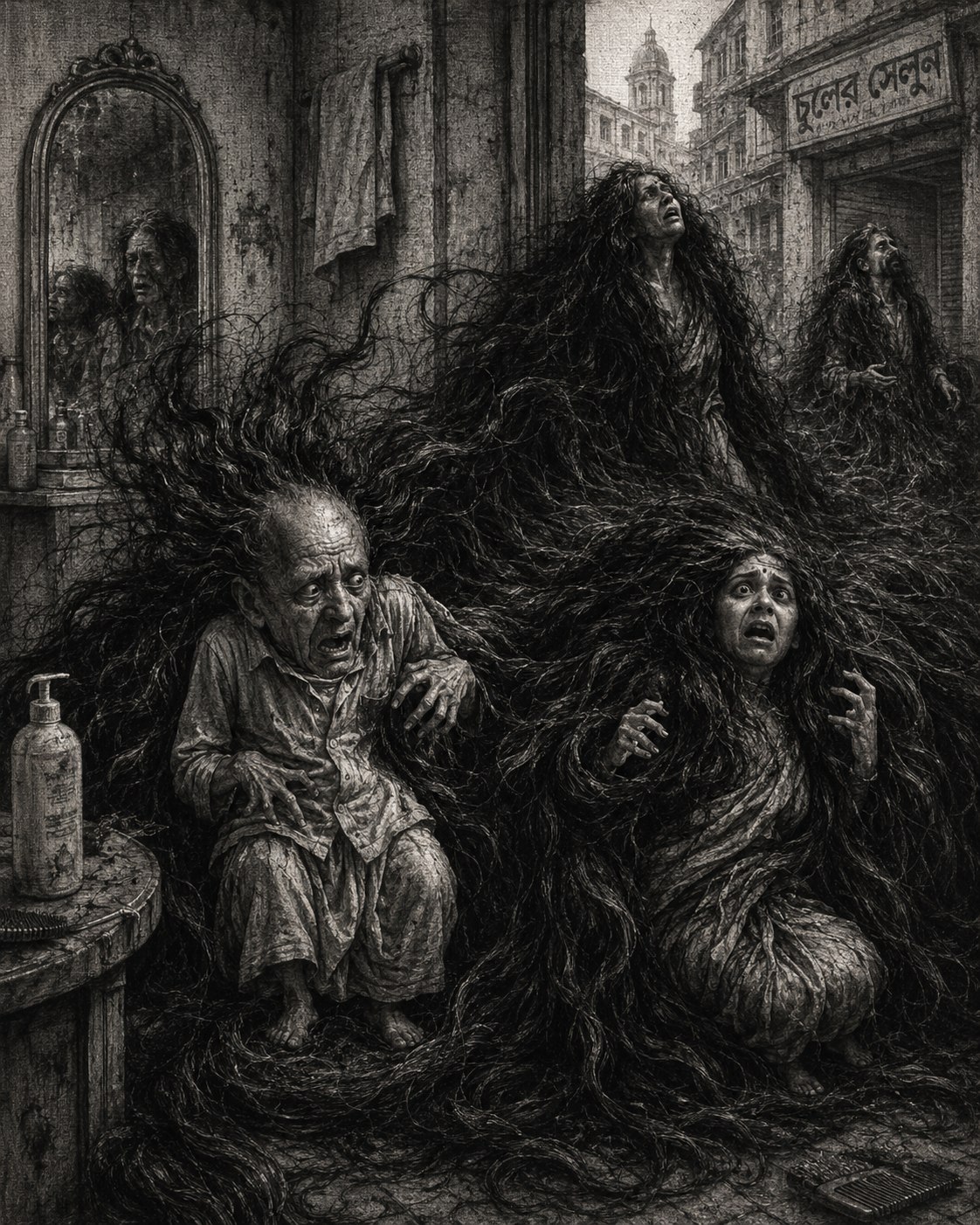
THIS IS A WORK OF FICTION
The first bottle came free with a newspaper.
Not the whole city’s newspaper. Calcutta does not receive anything all at once except rain, political lies, and the smell of frying telebhaja at dusk. This was more surgical. At a tea stall near Sinthee More, beside the old tram wires that still hung like defeated questions over B. T. Road, a boy in a yellow promotional T-shirt placed little green sachets under the folded copies of the morning paper and smiled with the professional despair of someone paid by the day.
KESHJOL HAIR REVIVAL SHAMPOO, the sachet said.
ROOTS REMEMBER.
Arka Sen saw the slogan while waiting for his tea.
A bus coughed black smoke into the crossing. Two schoolgirls stepped around a sleeping dog with the contempt of queens. A delivery rider argued with a traffic sergeant. Above them, a peeling poster promised English fluency in ninety days, government job coaching in six months, and hair in fourteen days. In Calcutta, ambition was sold most cheaply to those least able to afford delay.
“Dada, free,” the boy said, pushing a sachet toward him. “Use and see.”
Arka took it because free things had a way of entering poor households with the authority of scripture.
He was forty-six, unemployed in the official sense and intermittently useful in the unofficial one. He cleaned data for small companies that wanted the polish of science without the inconvenience of science. He lived in a third-floor flat off South Sinthee, in a building with cracked balconies, a permanently damp staircase, and neighbors who knew everyone’s courier habits. His own hair had retreated after his divorce, then after his father’s stroke, then after the freelance contracts began coming late or not at all. What remained on his head had the apologetic arrangement of a badly attended meeting.
He put the sachet in his pocket.
At home, his mother was sitting by the window, sorting coriander leaves with the seriousness of an auditor. She was seventy-four and small, though not yet the troubling kind of small. The ceiling fan turned above her in a tired circle.
“Tea?” he asked.
“You had tea outside.”
“How do you know?”
“You smell of burnt milk and other people’s sweat.”
On the television, an anchor shouted about civic beautification while a clip showed hawkers being removed from a pavement near Gariahat. The camera lingered not on the men losing their stalls, but on the cleared footpath afterward, as though emptiness itself had become a development project.
His mother glanced at his head. “You should use oil.”
“I should use money first. Oil later.”
She held up a small green sachet from the newspaper pile.
“You also got this?”
“Everyone got it. Mrs. Bose from downstairs says her niece used it. Very good result.”
“Mrs. Bose’s niece is twenty-two. At that age even brick dust works.”
“Don’t be clever. It doesn’t suit bald people.”
He laughed, but there was a pinch beneath it.
That evening, when the power cut came and the bathroom turned into a black ceramic cave, he tore open the sachet by phone light. The shampoo smelled of hibiscus, cheap perfume, and something faintly medicinal, like a hospital corridor after mopping. It foamed immediately, too much, covering his scalp in a softness that felt almost warm.
For a moment he imagined the old college photograph: Arka at Jadavpur, hair thick and unruly, one arm raised in argument, the world still arranged like a problem that intelligence could solve.
He rinsed.
The next morning, his mother touched his head while passing with tea.
“Ei,” she said. “Look.”
In the mirror he saw it. A darkening along the crown. Not hair exactly, not yet, but the suggestion of an answer. The scalp no longer shone.
By the third day, the bald patch was gone.
By the seventh, he had more hair than he had possessed at thirty.
The city noticed faster than any regulator could have. Keshjol vanished from pharmacies in Shyambazar, Lake Market, Behala, Baguiati, Dum Dum. Beauty parlours put up handwritten signs: KESHJOL TREATMENT AVAILABLE. Men who had spent years cultivating philosophical indifference to baldness began appearing at tea stalls with sheepish black waves. Women with thinning hair from thyroid trouble, childbirth, stress, anemia, grief, and the ordinary abrasion of being responsible for too many people stood in queues outside medicine shops before sunrise.
The advertisements changed tone within a week. First they had been humble. Then scientific. Then devotional.
ROOTS REMEMBER.
The face of the campaign was a Bengali film actress past her peak but not past her lighting. She stood in a white sari before a fake banyan tree and said, “My hair is my memory.” Behind her, animated follicles opened like flowers.
Arka was not surprised when the company called him.
He had worked for them the previous winter, before Keshjol had a name. Back then they were a small cosmetic startup operating out of a glass box in Salt Lake Sector V, with exposed brick walls and young founders who spoke of “disrupting confidence.” They had hired him to organize user-trial spreadsheets. Eight hundred volunteers, four cities, eight weeks. Hair density. Scalp irritation. Reported adverse events.
He remembered the adverse events.
Too many entries had said fatigue. Loss of appetite. Change in fingernail texture. One woman from Howrah had reported that her wedding ring had become loose. A retired bank officer from Baranagar wrote that his shoes felt large.
The founder, a soft-voiced man named Rishav Mallick, had told Arka to recode “non-scalp observations” as unrelated.
“This is cosmetic,” Rishav had said. “People imagine things.”
“People also measure rings,” Arka said.
“Dada, please. We are not curing cancer. We are selling hope in a bottle.”
Arka had needed the money. His mother’s blood pressure medicine had changed again, and the new one cost like imported sin. He recoded the fields. He sent the cleaned file. Keshjol passed whatever thin curtain of approval cosmetics required.
Now Rishav called him again.
“We need help monitoring post-market chatter,” he said. “Social media, complaint mails, pharmacy feedback. People exaggerate online. We need signal from noise.”
“What signal?”
A silence came through the phone, full of air-conditioning and withheld things.
“Growth complaints,” Rishav said.
“Isn’t that the point?”
“Excess growth.”
Arka looked at himself in the mirror. His hair fell over his forehead, thick, almost adolescent. His mother had begun calling him “college boy” in a way that pleased them both and embarrassed him privately.
“How much excess?”
“Come tomorrow.”
The office in Sector V had changed. There were security guards now, a larger reception, framed news clippings, a glass bowl of imported candies nobody touched. Outside, a tea seller did better business than the café inside because the city would tolerate many things, but not eighty-rupee tea.
Rishav looked thinner. His beard was trimmed, his shirt expensive, his eyes sleepless.
He took Arka to a conference room and opened a dashboard.
Complaints blinked across the screen.
Hair growing after shaving.
Hair growing from old scars.
Hair emerging from eyebrows into the forehead.
Hair blocking drains.
Hair inside ears.
Hair under nails.
“Any systemic?” Arka asked.
Rishav hesitated.
Arka clicked open a cluster of photographs.
The first was almost funny. A bald man in Howrah with a luxuriant mane down to his shoulders, standing proudly beside a plastic bucket.
The next was less funny. The same man one week later, hair to his waist, beard like a sadhu, face pinched.
The third photograph showed him sitting on a bed. His son stood beside him, holding a ruler against the wall. The man’s feet did not touch the floor.
“How old is this?” Arka asked.
“Two days.”
“How tall was he?”
“Five-seven.”
“And now?”
“Four-eleven.”
Arka closed the image.
Rishav spoke quickly. “Correlation isn’t causation. Many users are older. Vertebral compression. Malnutrition. Bad posture. You know how people are.”
Yes, Arka knew how people were. They bent facts toward salary, marriage, reputation, party loyalty, family peace. They bent until they mistook bending for wisdom.
“Why did you call me?”
“We need someone who understands dirty data.”
“That is not the flattering sentence you think it is.”
Rishav rubbed his eyes. “Our investors want calm. The state people want calm. The retailers want stock. We need to identify fake complaints.”
“And real ones?”
“Quietly.”
On the metro back from Salt Lake, Arka noticed hair everywhere.
Not dramatically. Calcutta rarely begins with drama. It begins with a man scratching his neck in the corner seat. With a college girl twisting her ponytail around her wrist because it has grown too heavy. With a child at Belgachia station staring at a clump caught in the escalator teeth. With an announcement asking passengers not to discard “personal grooming waste” on platforms.
At Shyambazar, a poster of a political leader had been defaced by rainwater. Strands of hair clung to the paste and fluttered against the wall like black grass.
At home, his mother had cooked musur dal and begun humming.
“You’re happy today,” he said.
She turned.
Her hair, which had been white and thin for years, was now silver and dense, braided down her back.
“You used it?”
“Only once.”
“Ma.”
“What? You used it.”
“I am younger.”
“And I am dead already?”
“That’s not what I said.”
She lowered the ladle. “All my life my hair was my pride. Your father liked it. After his stroke, after hospital, after money, everything went. I also wanted one foolish thing.”
He had no answer. Desire, he thought, was never foolish while it was starving.
Two days later, the first death came through a WhatsApp video.
A man from Kankurgachi sat in a plastic chair while two relatives tried to cut his hair with kitchen scissors. The hair moved in thick ropes, not by itself exactly, but with a wet springing resistance. The man was crying. He had shrunk so much his shirt hung from him like a curtain. Someone in the video said, “Hold him, hold him.” Someone else said, “Don’t cut near skin.”
The scissors snapped.
The hair tightened.
The man made a soft, astonished sound, like a person seeing an old friend in a crowd, and folded inward.
The video cut off.
By evening, the government issued an advisory asking citizens not to panic and to discontinue “non-essential cosmetic applications.” Pharmacies quietly removed Keshjol from shelves, then sold it from drawers at triple price to people who had not yet understood the shape of the bargain. Hospitals filled with patients whose hair had to be bundled, tied, lifted on hooks. Wards smelled of sweat, antiseptic, coconut oil, and fear.
Arka took his mother to R. G. Kar after she lost two inches in one night.
The emergency entrance was a forest.
Hair spilled from stretchers. Hair dragged behind wheelchairs. Hair came in black, brown, white, dyed burgundy, henna-orange, blue from some salon in Quest Mall, gold from dreams of Dubai. Men who had hidden baldness under caps now begged nurses to shave them. Women clutched at their heads and wept not from vanity but from the horror of abundance turning animal.
A young doctor with purple shadows under her eyes examined Arka’s mother.
“Height loss, weight loss, hair mass increase,” she said.
“Can you stop it?”
“We don’t know yet.”
“What is happening?”
The doctor looked at him. “Keratin synthesis is taking substrate from somewhere.”
“Somewhere?”
She glanced at his mother, then back at him.
“Everywhere.”
His mother, sitting on the bed with her braid coiled in a basin, said, “Speak properly. I taught mathematics. I am not a pumpkin.”
The doctor softened. “Your body is feeding the hair. Protein, minerals, maybe bone matrix. We’re seeing shrinkage because tissues are being consumed or compressed. We don’t know the mechanism.”
“Cut the hair,” Arka said.
“We cut, it regrows. Faster. Like pruning.”
A scream rose from the next cubicle, then stopped too suddenly.
The doctor flinched. “There is a research desk near the old outpatient wing. Give your product batch number.”
Arka gave it.
The man at the desk, wearing an ID card and a defeated tie, entered it into a laptop. “Promotional sachet?”
“Yes.”
“Newspaper batch?”
“Yes.”
The man looked up. “Those are the worst.”
“Worst how?”
Before he could answer, the lights flickered. The hospital generator coughed awake. In the three-second darkness between systems, the ward rustled.
It was not a human sound.
It was like a thousand small brooms sweeping a thousand closed rooms.
Arka began working that night.
Not for Rishav. For himself, or his mother, or whatever remained of decency after he had sold his portion at invoice rate. He still had the old trial files on an external drive because freelancers keep everything. Payment records, data dictionaries, raw adverse reports, deleted columns.
He sat at the dining table while his mother slept in the next room, her braid tied to the bedframe so it would not slide across her face. Outside, rainwater drummed on the balcony grill. Puja lights, installed too early by an enthusiastic local club, blinked red and green over a lane full of posters, puddles, and stray dogs.
The raw data told the story without poetry.
The strongest hair growth occurred in users with the lowest baseline body mass.
Women after childbirth.
Older men.
Diabetics.
People with anemia.
People under chronic stress.
People who reported skipping meals.
The formula did not simply grow hair. It converted lack into hair. It took the body’s stored compromises—the missed eggs, the cheap rice, the untreated thyroid, the years of being careful with money—and gave them visible glory.
There was a deleted column named K-Index.
Arka searched old emails.
He found one from a lab consultant in Hyderabad: “K-index elevation indicates systemic keratin appetite. Recommend discontinuation of trial group B, particularly participants below BMI threshold.”
Below it was Rishav’s reply: “Noted. For cosmetic classification please restrict commentary to scalp outcomes.”
Arka sat very still.
Then he found his own cleaned sheet, the one he had submitted. The K-Index column was gone.
In the next room, his mother called his name.
He found her sitting upright.
The bed was full of hair.
It had grown around the room in the hours since midnight, over the pillow, under the door, into the window grille, along the damp wall where old paint had blistered. Her face had sharpened. Her hands were child-sized.
“Cut it,” she said.
“I can’t.”
“Cut it.”
He brought scissors. The blades entered the hair and stuck. A tremor passed through the braid, not movement, not exactly, but awareness finding its corridor.
His mother closed her eyes.
“Arka,” she whispered. “It is pulling.”
“Where?”
“Back.”
He thought she meant the bed. He thought she meant her scalp.
“Back where?”
She opened her eyes, and for one moment she looked not younger but earlier, as if time had folded badly.
“To before,” she said.
By morning, the city had begun to shrink.
There was no official announcement. Official things require language, and language requires the confidence that reality will remain seated while described. Instead there were signs. Men standing on bricks to reach shop counters. Women pinning up saris that had become too long. Children suddenly taller than parents. Bus conductors lifting passengers by the armpits. A barber in Hatibagan sitting on the pavement, laughing and crying while hair poured from his own ears like black smoke.
At the corner tea stall, the owner had tied his hair to the shutter hook behind him. He served tea with one hand and kept pushing his slipping lungi up with the other.
“Dada,” he said to Arka, “you know computers. This is Chinese?”
“No.”
“Government?”
“No.”
“Then what?”
“Business.”
The tea seller nodded, satisfied. In Bengal, that explained enough.
Arka went to Sector V.
The Keshjol office was locked. A crowd had gathered outside: customers, journalists, two police constables, three men from a political youth wing who had arrived late enough to be furious safely. Someone had smashed the glass door. Inside, promotional standees lay on the floor, smiling under footprints.
Rishav was gone.
But Arka knew where to find him. Rich people fled upward when the ground became troublesome. Rishav had once boasted of his new flat in a gated tower near New Town, where the lobby smelled of lilies and nobody dried underwear on balconies.
The guard did not want to let Arka in. Then a power cut disabled the gate mechanism, and the residents began shouting at the guard with such class-specific injury that Arka simply walked through.
Rishav opened the door before Arka rang.
His hair was magnificent.
It reached his knees, glossy and black. He had shrunk to the size of a twelve-year-old boy. His expensive shirt had been belted around him like a robe.
“You shouldn’t be here,” he said.
“Did you know?”
Rishav laughed once. “Know? This is not murder in a detective serial. Nobody knows. People suspect. People postpone. People ask for more data. Then the purchase order comes.”
“My mother used it.”
“So did mine.”
That stopped Arka.
Rishav stepped aside.
In the living room, on a white sofa, sat a very small old woman almost buried in hair. Her face was calm. Her eyes moved toward Arka without interest. On the glass table beside her were protein drinks, calcium tablets, printouts, and a silver comb.
“She wanted to see herself once more,” Rishav said. “Before the end. Is that so evil?”
“Yes,” Arka said.
Rishav smiled. “You say that because you think evil is a separate room. It isn’t. It is the same room after the light changes.”
Arka took out his phone. “I have the raw files. Emails. K-Index. Your replies.”
“And yours.”
The word sat between them like a third person.
Outside, thunder moved over the new towers. Far below, the city spread wet and flickering: malls, flyovers, markets, old houses with moss-black walls, hospitals glowing with exhausted electricity, para clubs stringing lights for festivals that would arrive no matter who had hair, no hair, body, no body.
“Release them,” Rishav said.
“I will.”
“You’ll go to jail.”
“Maybe.”
“You’ll be famous first. For two days. Then they’ll find a larger scandal.”
Arka wanted to hit him. Instead he looked at the old woman on the sofa.
“Is there an antidote?”
Rishav’s face changed. For the first time, he looked honestly afraid.
“No.”
The old woman spoke. Her voice was dry and tiny.
“There is.”
Both men turned.
She lifted one hand from the hair. In it was a sachet, older than Keshjol’s green packaging, silver, unbranded.
“Trial formula,” she said. “Opposite.”
Rishav lunged toward her, but his hair caught under the table leg. He fell.
Arka took the sachet.
“What does it do?” he asked.
Rishav, on the floor, began to laugh.
“It stops hair growth,” he said. “Perfectly.”
“Then why didn’t you use it?”
His laughter thinned.
His mother answered. “Because it also stops everything that grows.”
Arka understood.
Nails. Skin. Blood. Gut lining. Healing. The small daily repairs by which the body forgives being alive.
He ran home through rain.
By then South Sinthee looked like a drowned puppet theatre. People leaned from balconies, shouting for medicine, scissors, priests, doctors, relatives abroad. A man dragged a sack of his own hair behind him. A little girl held her father’s enormous shirt closed around his reduced body and scolded him for crying. At a coaching center, the signboard had fallen, revealing an older sign beneath for a video cassette library, then an older one for a tailoring shop, Calcutta exposing its past in layers while its people were pulled toward infancy by their own vanity and hunger.
His mother was smaller.
Not childlike. Doll-like.
Her hair filled half the room. It had entered the cracks in the wall and the drain hole of the bathroom. It had wrapped around chair legs, books, the gas cylinder, the old framed photograph of his father.
“I found something,” Arka said.
She looked at the sachet.
“No.”
“It may stop it.”
“No.”
“It may kill you.”
She smiled faintly. “This is your sales pitch?”
He knelt beside her. His own hair brushed the floor now. His wrists had become thin. His watch slid to his hand.
“I caused this,” he said.
“You did not invent it.”
“I helped hide it.”
“Same family, different cousins.”
“I am sorry.”
She touched his face with fingers light as paper.
“You were always sorry before doing things. It never helped.”
He wept then, not loudly, because Calcutta flats have thin walls and even grief observes neighbors.
His mother looked past him toward the rain-wet balcony. “When you were small, you had so much hair. People said, what a beautiful boy. You hated combing.”
“Ma.”
“I used to hold you between my knees and part your hair. You would shout as if I was murdering you.”
He laughed through his nose.
She said, “Give me the sachet.”
He mixed it in a bowl with water. It did not foam. It became clear and flat.
He poured it slowly over her scalp.
The hair stopped moving.
Not falling. Not retreating. Simply stopping, like a crowd hearing bad news.
His mother exhaled.
For three days, she lived.
In those three days, Arka released everything. The files went to journalists, doctors, strangers, enemies, anyone with an inbox. Rishav was arrested at the airport disguised in a child’s hoodie, though the disguise was no longer entirely a disguise. The company denied criminal liability. The state announced compensation. Pharmacies denied black-market sales. Influencers deleted old videos. The actress from the advertisement posted a candle emoji.
The city kept shrinking.
Not everyone. Only those who had used enough. Only those whose bodies had something left to surrender. The rich entered private clinics and came out diminished but alive, their hair sealed in medical sacks. The poor became rumors first, then statistics, then municipal difficulty.
Arka’s own shrinkage slowed after he used the remaining antidote on himself. His hair stopped at his waist. His skin stopped healing. A nick from shaving stayed open. His gums bled. He learned to move carefully through the flat, now too large in some ways and too crowded in others.
His mother died before dawn on the fourth day.
The hair around her had turned white.
When the men came to take the body, they could not lift all of it. Hair had rooted into the room. They cut what they could, muttering, sweating, making practical jokes because that is how working men survive the obscene requests of the world.
Afterward, Arka sat alone beside the window.
Rain had washed the lane clean for approximately seven minutes. The tea stall reopened. Someone argued about fish prices. A metro announcement floated faintly from the distance, polite and useless. On the opposite balcony, Mrs. Bose’s niece stood brushing her new hair with slow, terrified strokes.
Arka’s phone buzzed.
A message from an unknown number.
Sir, I got your contact from online. My father used Keshjol. He is very small now but alive. Hair not stopping. Please send antidote name.
Then another.
Then twenty.
Then hundreds.
He looked at the empty silver sachet on the table.
At the bottom, in print so faint he had not noticed before, was a line of text.
PROPERTY OF KESHJOL LABS: CHILD RESTORATION SERIES.
Arka read it again.
Not hair revival.
Child restoration.
Behind him, from the bedroom where his mother’s hair still threaded the wall, came a small sound.
Not a ghostly sound. Not dramatic. A living sound.
A baby coughing.
Arka stood very slowly, because his knees were weak and the flat had grown enormous, and the city outside went on selling tea, hope, and other formulas under the rain.